Yes, the letter “I” is capitalized when it stands alone…
If you’ve ever tried to teach a middle schooler how to write an essay, you know it’s not just about thesis statements and topic sentences—it’s about survival. It’s guiding students who think “because I said so” is valid evidence and believe their five-paragraph paper should somehow be five sentences total.
And yet, it’s also one of the most rewarding parts of teaching. Because somewhere between the “what’s a hook?” and the final draft, they grow. Their voices emerge. Their confidence builds. And honestly? It’s kind of amazing.
Step One: Explaining What an Essay Actually Is
Middle schoolers have strong opinions—on everything. TikTok trends, lunchroom drama, the injustice of dress codes. But ask them to write a formal argument and suddenly it’s like you’ve asked them to write a dissertation on the molecular structure of boredom.
So we start with the basics:
- What is an essay? (A structured way to share ideas—not a free-for-all, not a text message)
- Why do we write them? (To persuade, explain, or inform—not to fill space)
- What’s a thesis? (No, not a new font on Google Docs)
It’s like building a house. Except the wood is imaginary, and your workers are 13-year-olds with very strong feelings about snacks.
Step Two: The Outline Resistance
The second I say “outline,” I can feel the collective eye-roll. They want to skip to the fun part (typing something quickly and printing it before class). But outlines are where the magic happens—where half-formed thoughts become actual points, and kids realize maybe they do have something to say.
I push for structure:
- Intro: Hook them! State your claim!
- Body Paragraphs: One point at a time, evidence included
- Conclusion: No, you can’t just write “That’s why I’m right.”
Half of them try to write the entire paper in one massive paragraph. The other half ask if emojis are acceptable. Progress is slow, but it’s coming.
Step Three: Drafting Chaos
Draft day arrives like a storm: pencils tapping, Chromebooks freezing, kids panicking because they “can’t remember their password.” Some write too much, others too little, and one student manages to turn their persuasive essay on recycling into a rant about why pineapple doesn’t belong on pizza.
And yet… they’re writing. They’re trying. They’re finding their voice, even if it’s loud, messy, and a little all over the place.
Step Four: The Magical Power of Revision
Now comes the real teaching moment. We talk about revision, not just editing. More than just spelling mistakes and grammar corrections, we talk about clarity, purpose, and audience.
I read lines like:
“Pollution is bad because no one wants a dead ocean.”
And we workshop that into:
“Ocean pollution threatens marine life, disrupts ecosystems, and impacts human communities worldwide.”
We celebrate improvements. We laugh through the cringey first drafts. And I remind them that good writing is rewriting.
The Payoff: Growth You Can See
By the end, even the students who swore “I can’t write!” hand in something they’re proud of. Not perfect. Not Pulitzer-worthy. But theirs.
I watch their confidence grow. Their voice becomes clearer. They start to understand that writing isn’t just a school assignment—it’s a way to express who they are and what they believe.
Final Thoughts
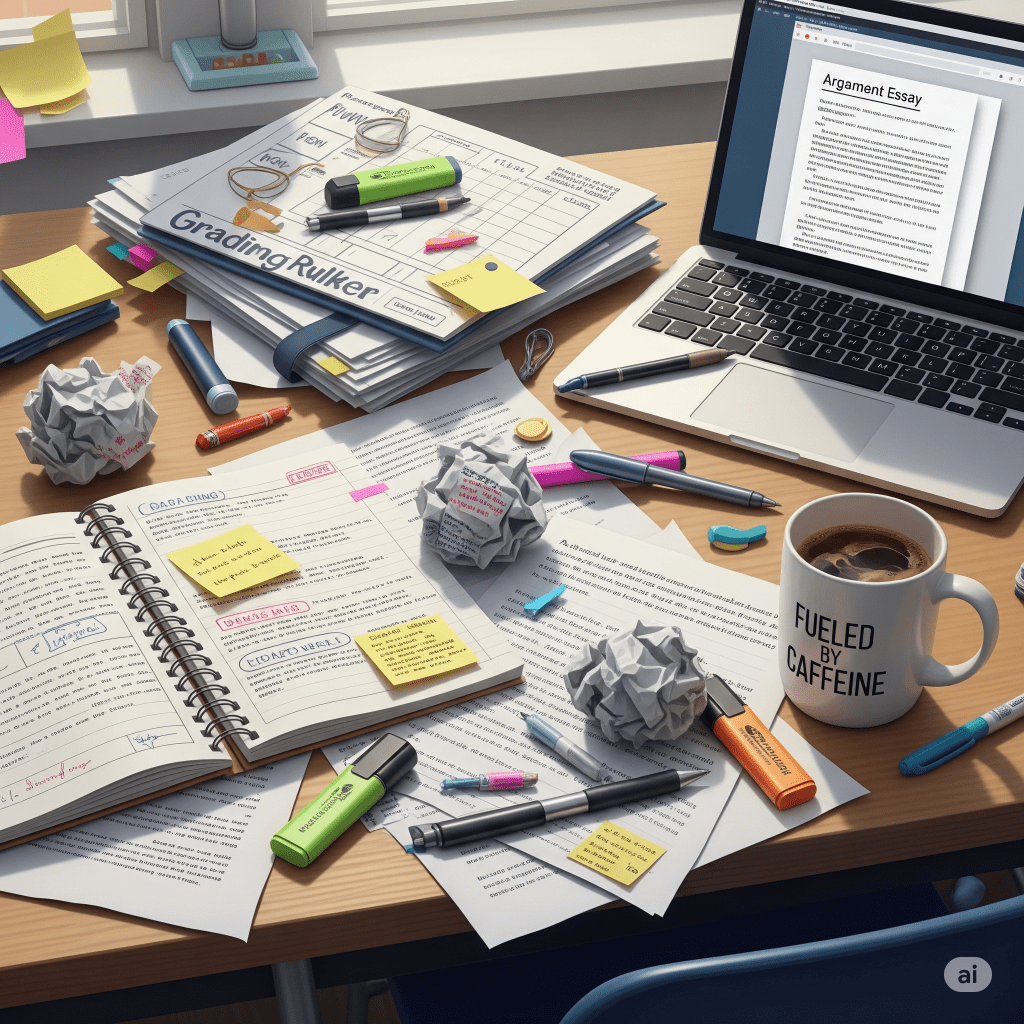
Teaching middle schoolers how to write essays is an unpredictable adventure—equal parts chaos and clarity, grammar and growth. It’s sticky notes, revision checklists, and “what do you mean I can’t start a paragraph with ‘Anyways…’?”
But in the end? It’s worth every moment. Because teaching them how to write is really about teaching them how to think—and that, my friends, is where the real learning begins.
__________________________________________________________________
Okay okay….my first bit of actual advice you may or may not choose to use
Here’s a brief OUTLINE of how I teach my kids to write 5-paragraph argument essays: Use or toss :)
Introduction: Hook, Bridge, Thesis
(No, you can’t start your essay with “Hi, my name is ____________ and today I am going to be talking about…”) Ew. No. Get out.
Body Paragraph 1: Topic Sentence, followed by 5-7 sentences that draft evidence followed by explanations as to why that evidence relates and proves your thesis is true and accurate.
Body Paragraph 2: Topic Sentence (your second reason/point), followed by 5-7 sentences that draft evidence followed by explanations as to why that evidence relates and proves your thesis is true and accurate.
Body Paragraph 3: Most often your Counterargument and Rebuttal Paragraph (in their minds they think, “you mean everyone doesn’t think the way I do?!”) where students have to truly think outside the box and predict what others, who don’t agree with them, might argue to prove their own point, and then the rebuttal is where they prove them wrong. Boom. Mic drop.
Conclusion: Thesis, Review Main Ideas, Lasting Impression (aka “Mic Drop Moment”)
And let me leave you with this one final piece of advice….NO, WIKIPEDIA IS NOT A CREDIBLE SOURCE.

 Coffee ☕️ Crayons 🖍️ and Curriculum 📝
Leave a reply to skeldonc Cancel reply